
Advanced referral savings fell 26.7% in Q1 2026. The lever that still moves is specialty—and it sits in pharmacies most programs never registered. Why a standard proforma projects almost nothing for referral capture, what one Indianapolis FQHC captured instead, and why the OPAIS registration window closes soon.
Our November Mission Control Monthly put three numbers on January 1 (17%, 83%, and $50), and this four-item list turns them into what to do now, so more of your 340B savings keeps funding care for your patients.
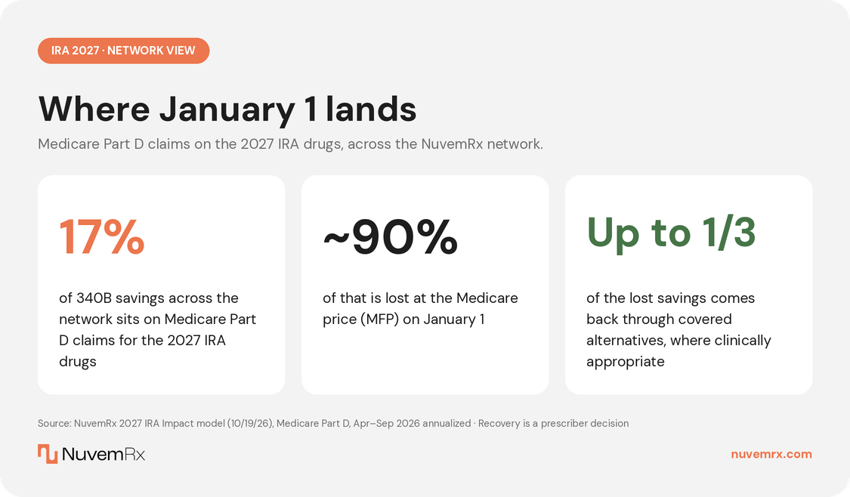
What we found is that 17% percent of the 340B savings across the NuvemRx network sits on Medicare Part D claims for the 2027 IRA drugs. On January 1, about 90% of that is lost at the Medicare price.
That loss is real, and no amount of planning makes it zero. It also arrives on the same day HRSA's 340B rebate pilot goes live, which is why January 1 sounds like a cliff in almost every conversation about it.
The numbers draw a smaller and more specific picture. We put them on the table at November's Mission Control Monthly: what the new Medicare prices take, what the rebate model does to your cash, and a Medicare program that sits outside both. Carrie Galvan, Senior Director of our Technical Assistance Center, closed the session with the list to work from.
17%, and the third you can win back
The IRA hit is concentrated. It lands on Medicare Part D claims for the 15 drugs whose negotiated prices take effect January 1. Across our network, those claims carry 17% of covered entity savings, and about 90% of that disappears once they reprice.
Some of it comes back. Most of the IRA drugs have a therapeutic alternative that keeps its 340B value, and across the network, covered alternatives recover up to a third of the lost savings. That recovery happens one prescriber decision at a time, and only where it's clinically and therapeutically appropriate. So it starts where Carrie starts: knowing which of your drugs carry the exposure, by product line and by drug, and putting that list in front of your providers.
83%, and the accounts that need a phone call
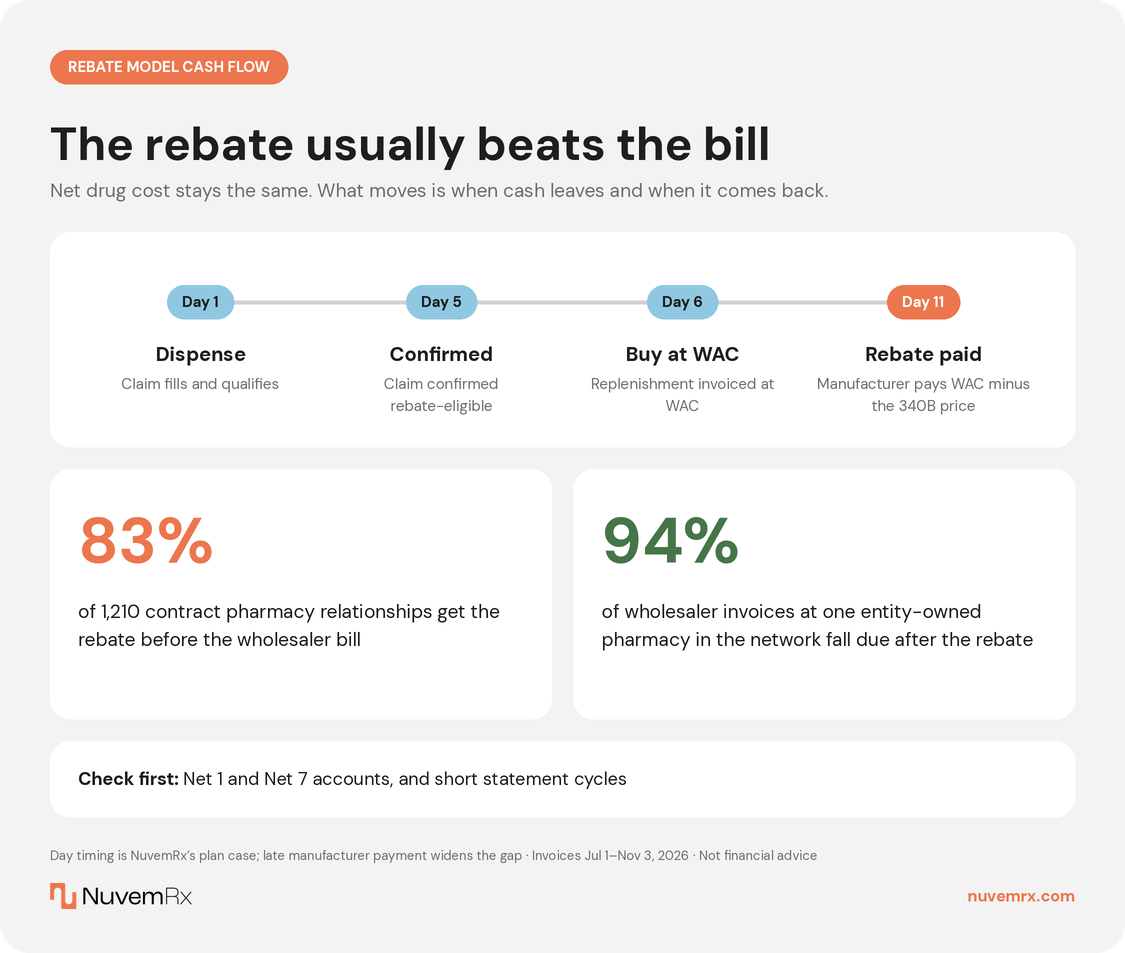
Under the rebate model, you buy the pilot drugs at WAC, and the manufacturer pays the 340B difference back later as a rebate. Your net drug cost stays the same. What moves is when the cash leaves and when it comes back.
So the question that matters is whether the rebate arrives before the wholesaler bill. Mission Control checked the payment terms on 1,210 contract pharmacy relationships across the network, and in 83% of them the rebate lands first. At one entity-owned pharmacy in the network, 94% of wholesaler invoices fall due after the rebate.
The exceptions are specific, and you can find them now: accounts on short fixed terms like Net 1 or Net 7, and short statement cycles. Carrie's line is a ten-day payment cycle. Anything shorter, call your wholesaler about extended terms. Check your credit line in the same week, because buying at WAC puts more weight on it, and every day a manufacturer pays late adds to what you're carrying.
One more thing about that call. Some 340B administrators are owned by the wholesalers on the other end of it. When you ask for better terms, it helps to bring the analysis from a partner with no other side of that table.
$50, outside Part D
The third change is already running. The Medicare GLP-1 Bridge covers weight-management GLP-1s for Medicare beneficiaries at $50 a month, from July 1, 2026 through December 31, 2027. CMS runs it as a Section 402 demonstration rather than a Part D plan, so the January 1 Medicare price on semaglutide doesn't reach Bridge claims.
That makes the Bridge a reason to revisit patients with obesity whose care may have been overlooked. Some went untreated, or stayed on something subtherapeutic, because a new start on an IRA-affected drug looked hard to sustain. Eligibility depends on BMI and qualifying conditions. Patients with type 2 diabetes, moderate-to-severe sleep apnea, or MASH stay in their Part D plan, and the provider's judgment and the prior authorization decide. A single central processor handles the prior authorization, the claim, and payment to the pharmacy.
The list
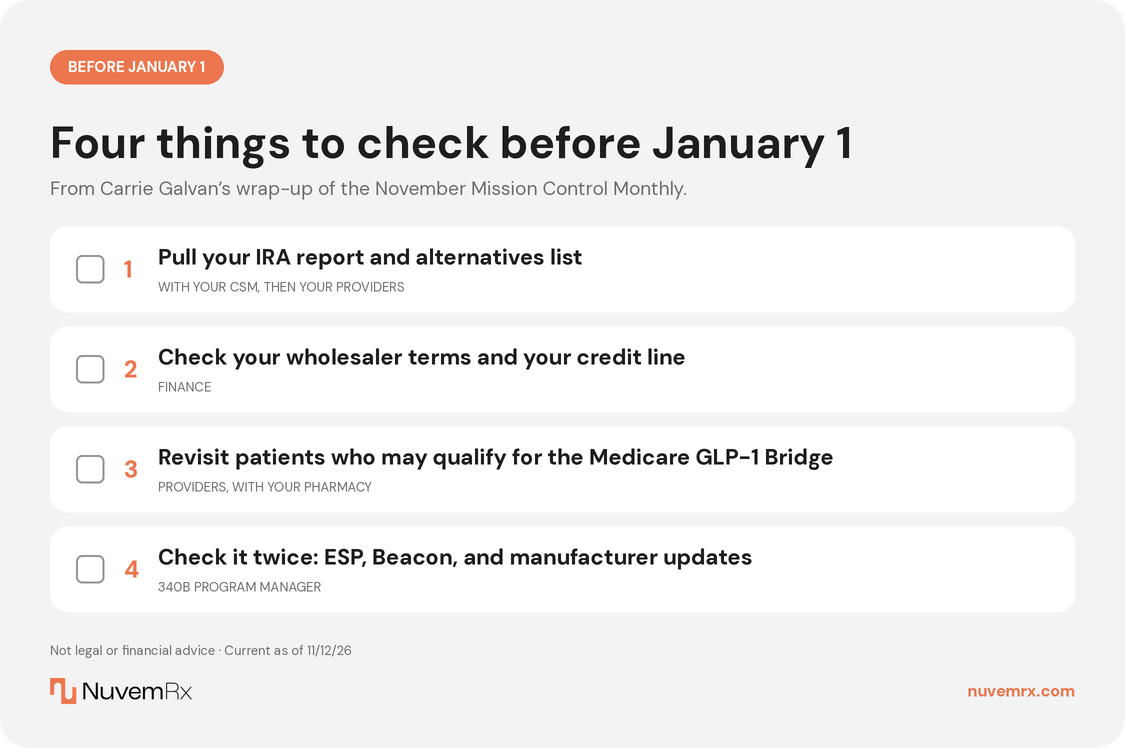
What to do, in order:
- Pull your IRA report and alternatives list, then share it with your providers.
- Check your wholesaler terms and your credit line.
- Revisit patients who may qualify for the Bridge.
- Check it twice: ESP designations, Beacon registration with NuvemRx connected to submit your claims data, and manufacturer platform updates.
Why we see it first
These numbers come from claims, invoices, and wholesaler terms across the network NuvemRx supports, more than 800 covered entities. A single program sees its own payment terms; Mission Control sees them next to more than a thousand other pharmacy relationships. That view is how Mission Control can tell you which accounts need a phone call before January, not after.
It also helps that contract pharmacy, entity-owned pharmacy, and referral capture run through one partner, so your IRA report covers your whole program in one place.
January 1 takes a real share of 340B savings off the table. What you do in the next seven weeks decides how much of the rest keeps reaching your patients: the pharmacist hours, the staff, and the services your health center funds with it.
If you're a NuvemRx client, your CSM can walk you through your entity's IRA report and wholesaler-terms scenario. If you're not, start a conversation below. December's Mission Control Monthly will covers January 1 go-live readiness, denial tracking, and rebate reconciliation.
Bookmark this link for continually updated resources and insights to help pharmacy become the engine that drives expanded care for your community.
This article is general information for 340B covered entities and is not legal, tax, accounting, financial, or clinical advice. It reflects HRSA’s 340B Rebate Model Pilot Program notice (August 3, 2026), CMS’s negotiated Maximum Fair Prices for initial price applicability year 2027, and CMS’s Medicare GLP-1 Bridge guidance as of November 12, 2026. Program timing, manufacturer policies (including platform requirements on Beacon, 340B ESP, and Truzo), and CMS processes may change, so check each source’s current guidance before acting. NuvemRx figures come from NuvemRx network analyses: the 17%, about 90%, and up-to-a-third figures from the NuvemRx 2027 IRA Impact model (Medicare Part D claims, April–September 2026 annualized); the 83% figure from payment terms observed on 1,210 contract pharmacy relationships (invoices July 1–November 3, 2026); and the 94% figure from a single entity-owned pharmacy. Your program’s results will differ. Any recovery through therapeutic alternatives depends on prescriber decisions made where clinically appropriate. Rebate timing shown is a planning case; actual timing depends on manufacturer payment and your wholesaler terms. Medicare GLP-1 Bridge eligibility is determined by the treating provider and the program’s prior authorization process. “800+ covered entities” is company-wide and spans all NuvemRx solutions. Client reports referenced here are available through your Customer Success Manager when NuvemRx supports your program. Consult your own advisors, and confirm the requirements that apply to your organization.