
Participation is voluntary for manufacturers. It isn't for you. If HRSA approves a manufacturer's plan, the drugs in scope move to a rebate—you buy at wholesale acquisition cost and wait for the discount to come back. That's a cash-flow change before it's a compliance change, and the work that decides how January goes happens in October. Six actions, grouped by who owns them, with a printable checklist.
.png)
Manufacturer plans for HRSA's revised 340B rebate model pilot were due August 24, 2026. HRSA has said approvals, if any, will be issued by September 24. If the pilot proceeds, it begins January 1, 2027.
For a defined set of drugs, you would acquire at wholesale acquisition cost rather than the 340B price, and receive the discount afterward as a rebate on submitted claims. The scope is narrow—the Medicare-negotiated drugs for initial price applicability years 2026 and 2027, which HRSA sizes at less than 5.5% of total 340B sales. But these are high-cost, high-volume drugs, so the working capital they tie up is concentrated.
And if it proceeds, you won't be able to opt out. Participation is voluntary for manufacturers; once HRSA approves a manufacturer's plan, the notice says it “will become mandatory for 340B covered entities acquiring 340B drugs from that manufacturer.” The pilot doesn't reduce what your 340B program is worth to your community. It changes when the money arrives and who has to prove the claim.
Both of those land on pharmacy.
For most community health centers, pharmacy is the engine—the part of the operation that generates the savings that pay for the extra clinic hours, the added provider, the route the mobile unit runs in February.
How well that engine absorbs a timing change is how much care stays funded.
You have about four months. Here are six things to do:
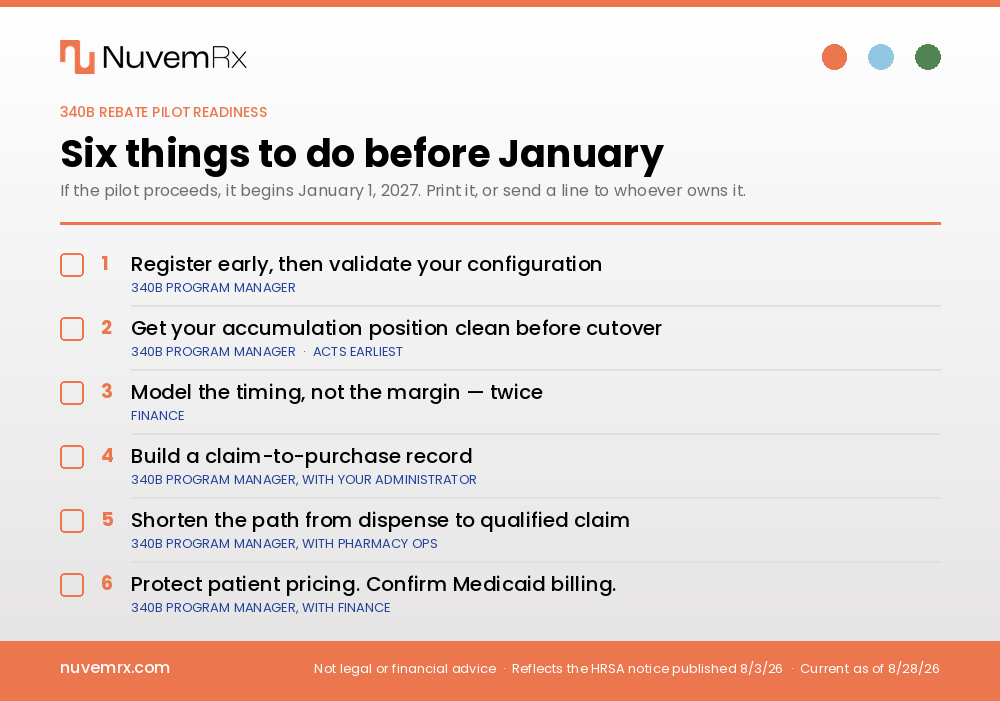
Each one is unpacked below, then the dates and what's still open.
1. Register early, then validate your configuration
Owner: your 340B program manager, delegating as appropriate.
Registering is the easy half. The half that gets skipped is confirming your accounts, identifiers, and submission routing are right before live money moves through them. Register early, so that when something is misconfigured there's still time to fix it.
Note that HRSA designated no platform. Each manufacturer's plan names its own and the manufacturer pays for it, so plan for the possibility of submitting across more than one. Worth asking whether any manufacturer-specific exception reaches you, too—plans may carry exceptions that don't apply broadly to all covered entities, and those must be disclosed to HRSA and to the entities affected.
2. Get your accumulation position clean before cutover
Owner: your 340B program manager, with purchasing if you run an in-house pharmacy. Acts earliest—decisions land in October and November.
What straddles the cutover isn't inventory on your shelf. That was already purchased, at the price in effect when you bought it. What straddles the cutover is accumulation that hasn't been purchased against yet—dispenses waiting on replenishment when the rules change underneath them.
The notice gives you a narrow allowance for exactly that. Plans must accommodate up to two unreplenished accumulated packages, with a 15-calendar-day grace period before the effective date in which you can still submit rebate requests on them. HRSA's own example: a covered entity may request a rebate for up to two packages of a product dispensed from neutral inventory on December 16, even though the product's participation begins January 1—and that request still has to be made within 45 days of dispense.
Two packages is a landing strip, not a runway. Everything past it wants to be replenished before January 1, because anything unresolved at cutover becomes a reconciliation problem stacked on top of a submission workflow your team is learning in real time. Two hard problems in the same week is a staffing question, not a pharmacy question.
The purchasing decisions that set your December position get made in October and November, which is why this one acts first.
3. Model the timing, not the margin—twice
Owner: finance. Bring your CFO in for this one.
Most impact models get pointed at margin. Wrong instrument. Under the pilot, the discount arrives in full; what changes is when. The exposure is a timing line.
The rebate itself is simple arithmetic: per the notice, wholesale acquisition cost less the 340B ceiling price on the day of dispense, paid at the unit level. So take your monthly pilot-drug purchase volume, price that difference, and carry it forward two months. That's working capital you need available in January that you didn't need in December. Run it against payroll and payables, because that's where the gap lands.
Then run it twice, because entity-owned and contract pharmacy behave differently enough that a single blended number will be wrong in both directions. Entity-owned carries inventory investment, working capital, patient discount methodology, and drug purchasing. Contract pharmacy carries replenishment timing, dispensing fee methodology, settlement timing, denied rebates, and forecasted net revenue. One number labeled “rebate impact” hides all of it.
HRSA's position is that the impact is modest, citing outside analyses putting the interest cost between 0.03% and 1.2%, and pointing to prompt payment, unit-level processing, and the starting-inventory grace period as mitigations. Those mitigations are real. Whether the residual gap is modest for your balance sheet is a question only your own numbers answer—better in October than in February.
4. Build a claim-to-purchase record
Owner: your 340B program manager, with your administrator. Longest lead time on the list.
Denied rebates are yours to challenge, and the notice gives you more to work with than most coverage suggests. The grounds for denial are narrow: plans must ensure rebates are not denied over eligibility concerns, diversion, or Medicaid duplicate discounts, and rebates “may not be denied for perceived lack of WAC purchases.” A manufacturer with those concerns must raise them with HRSA directly or use the existing statutory mechanisms—audits and administrative dispute resolution—rather than by denying the rebate. Denials also require documented rationale.
That's real standing. But it only converts into money if you can show which claims linked to which purchases.
Two things follow. Prevention beats appeals: check your configurations now for duplicate-discount and eligibility exposure, because the cheapest denial is the one that never happens. And producing the claim-to-purchase record is your administrator's job, not yours—if you can't get that listing on demand today, that's a conversation to have well before January.
Closing the gap does double duty, because much of the same evidence is what the 340B ESP purchase validation module is already asking for. One body of work, two requirements.
5. Shorten the path from dispense to qualified claim
Owner: your 340B program manager, with pharmacy operations.
Your manufacturer's plan must allow at least 45 calendar days from date of dispense. Some may allow more. Either way, don't work to the deadline—submit as early as you can, because the 10-day payment clock only starts on a complete submission, and incomplete data restarts it.
Three things tighten under that clock: how fast outside documentation gets pursued, how long your internal look-back and reprocessing windows run, and how quickly a qualified claim moves into replenishment.
Referral claims feel this first, because they're the ones waiting on a consult note from a specialist you don't employ. Across the 500+ covered entities on our referral network we see how long that documentation cycle actually runs, and it is routinely longer than 45 days. Under today's model, a claim that takes 60 days to document is late money. Under the pilot, it's a purchase whose discount arrives late or not at all.
That gap is why NuReferrals powered by par8o, automates up to 85% of the referral capture process—the automated portion is precisely the manual chasing that consumes the window.
6. Protect patient pricing. Confirm Medicaid billing.
Owner: your 340B program manager, with finance and whoever sets your sliding fee schedule.
These are two separate exposures that share one cause: your acquisition cost on these drugs is about to change.
On patient pricing. If your sliding fee scale is tied to acquisition cost, a WAC purchase price mechanically raises what an uninsured patient could be charged. That isn't a downstream effect to absorb. It's a decision leadership makes on purpose: will you hold your discount steady and carry the difference until the rebate lands?
On Medicaid. Confirm with your state what it expects on submission and on 340B claim identification. There's a sharper reason than tidiness: duplicate discounts are one of the few grounds on which a rebate can legitimately be denied. If your Medicaid billing doesn't reflect the post-rebate price, that risk sits with you.
HRSA anticipated the mechanics for both. Plans must make a quarterly 340B price file available for each of the manufacturer's 11-digit NDCs, expressly so covered entities can account for actual post-rebate acquisition cost in pharmacy billing systems for Medicaid billing, and to assist with sliding fee scales and patient cost sharing. Worth asking your administrator now how that file will reach you—the notice requires it to exist without specifying the delivery path.
The complexity of a rebate model belongs with us. It shouldn't reach the counter.
The dates
|
When |
What happens |
What it means for you |
|
Aug 24, 2026 |
Manufacturer plans due to HRSA |
Deadline passed. Contents aren't public until approval. |
|
Sept 24, 2026 |
Nothing is settled until they are. Which manufacturers participate is still unknown. | |
|
After approval |
90 calendar days' notice to covered entities |
Plans must give you this. Your formal warning window before one goes live, and changes to an approved plan need HRSA review first. |
|
Oct-Nov 2026 |
Your purchasing decisions |
When your December accumulation position actually gets set. Item 2. |
|
Before the effective date |
15-calendar-day grace period |
Rebate requests allowed on up to 2 unreplenished accumulated packages dispensed before the pilot starts. |
|
Jan 1, 2027 |
Go-live |
Pilot-drug purchases move to WAC. The timing gap opens. |
|
By April 30, 2028 |
HRSA publishes its evaluation |
The pilot runs a minimum of one year. Not a one-quarter disruption. |
What's still unsettled
Legally. An earlier version of the pilot was challenged in 2025 and vacated on Administrative Procedure Act grounds, after a court found HRSA hadn't adequately considered its impact. The 2025 pilot was enjoined and then vacated after a court found HRSA hadn't adequately considered its impact under the Administrative Procedure Act. The revised notice rewrites that justification and includes plan requirements intended to protect covered entities, but whether it satisfies the same standard is untested and further challenges are likely. On the legislative side, the SUSTAIN 340B Act—introduced August 5 by a bipartisan Senate working group, and the most recent of three bills in play—signals a preference for upfront discounts over rebates. That's a signal about appetite, not a change in the rules. Changing the rules takes an act of Congress.
Operationally. Even with approved plans, plenty stays open: which manufacturers participate and what their plans require, which platforms you'll submit through, whether any manufacturer-specific exceptions reach you, how consistent payment timing turns out to be, and how the dispute pathway performs the first time you use it in anger.
You don't need those answers to start. All six items are executable without them. And if the pilot is halted, the standard 340B flow simply continues—while you're left with a cleaner accumulation position, tighter replenishment, a real cash-flow model, and documentation that maps claims to purchases. None of that is wasted work.
One note if this feels familiar: a lot of programs built readiness plans in 2025, then the court stopped the pilot and the work went into a folder. Reopen it rather than trusting it. Staff have turned over, the drug list has changed, and the 2025 platform approvals were vacated—this round starts over.
Two things are already working in your favor. If your program has handled Maximum Fair Price effectuation, you've run a retrospective refund process end to end—expected, received, missing, disputed, resolved—so you have a template rather than a blank page. And the documentation work pays twice, because what you build for rebate challenges is largely what purchase validation already wants.
Why this is worth the effort
It would be easy to read a rebate pilot as one more administrative burden aimed at safety-net providers. Some of it is. But the reason to do this work carefully isn't compliance.
Pharmacy is the engine. In most community health centers, it's the most reliable generator of the margin that funds everything patients actually see—the extended hours, the filled clinical role, the program that never had a grant behind it.
A rebate model doesn't shrink that engine's output. It puts a delay between the output and the fuel tank, and asks you to document every gallon.
Programs that treat pharmacy as a back-office function will feel that delay as a shock. Programs that treat it as the engine will have instrumented it, staffed it, and modeled it before January—and will be positioned to keep funding that care right through the transition.
That's the whole point. Not the dollars. What the dollars pay for.
Where a partner should be carrying weight: two of these six are yours and can't be delegated—the purchasing decisions behind your accumulation position, and the cash-flow model that goes to your board. The rest should be largely absorbed by whoever administers your program.
At NuvemRx, rebate handling is part of our standard service offering: pilot NDCs will be flagged and submitted automatically, and paid-or-denied status will flow back through inventory, replenishment, and invoicing as one connected record.
Ownership structure is worth understanding too, whoever you work with. Ours is straightforward—no PBM or wholesaler parent. NuvemRx is 100% dedicated to safety-net providers.
Working with a NuvemRx CSM? Ask for your rebate readiness plan before the registration window opens.
Not yet a client? Start a conversation at nuvemrx.com—or just take these six and run them yourself. They work regardless.
This article is general information for 340B covered entities and is not legal, tax, accounting, or financial advice. It reflects HRSA's 340B Rebate Model Pilot Program notice published in the Federal Register on August 3, 2026 (Vol. 91, No. 147; document 2026–15633), and the status of the program as of August 26, 2026. Manufacturer rebate plans had not been approved or published when this was written, and approved plans may differ from one another in ways that affect the guidance above. Consult your own advisors, and read the plans that apply to your organization.