
An in-house pharmacy is one of the few moves a Federally Qualified Health Center can make that improves patient care and pays for it at the same time. Patients fill prescriptions before they leave the building. More of your 340B savings stay inside your walls instead of leaving as dispensing fees. And the cash flow you capture funds the services your community needs next.
But an in-house pharmacy program isn't a room with a pharmacist in it. It's a licensed, compliant, revenue-generating operation, and how you launch it decides whether it becomes a sustainability engine or a stalled construction project.
Here's what it takes, and what to look for in a partner before you break ground:
What an in-house pharmacy does for an FQHC
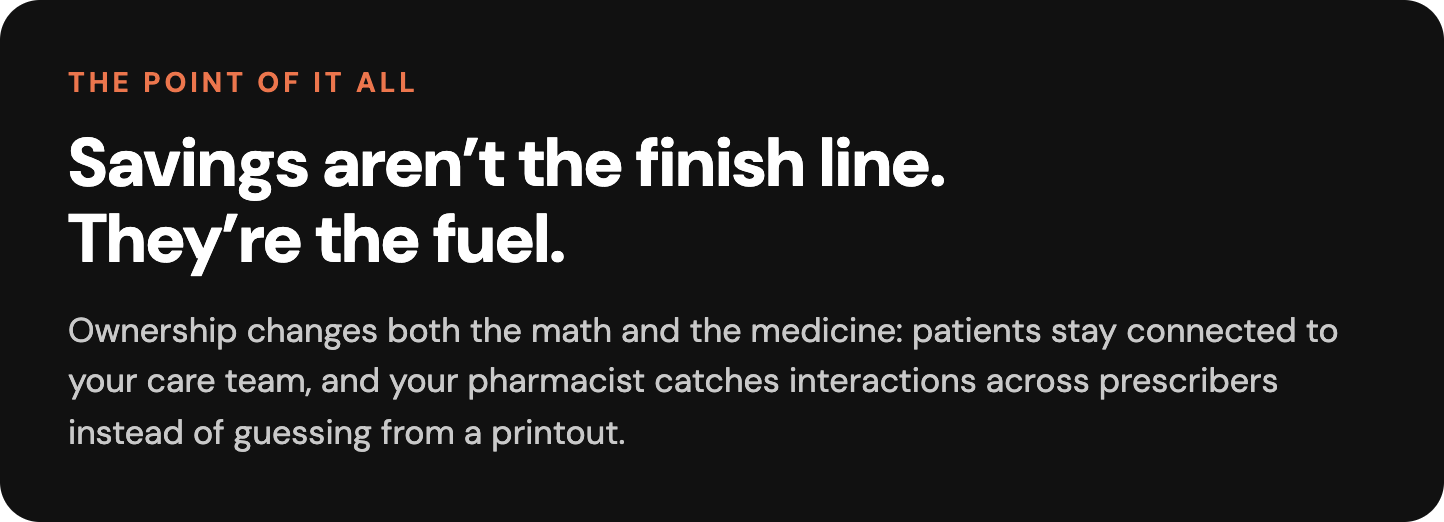
An in-house (entity-owned) pharmacy is one your health center owns and operates, rather than a third-party retail counter you contract with to dispense your 340B prescriptions. That ownership changes the math and the medicine.
Your pharmacist works alongside your providers, catching interactions and duplications across prescribers instead of guessing from a printout. And because eligible prescriptions run through your own pharmacy, you're insulated from the manufacturer restrictions that keep tightening on contract pharmacy arrangements.
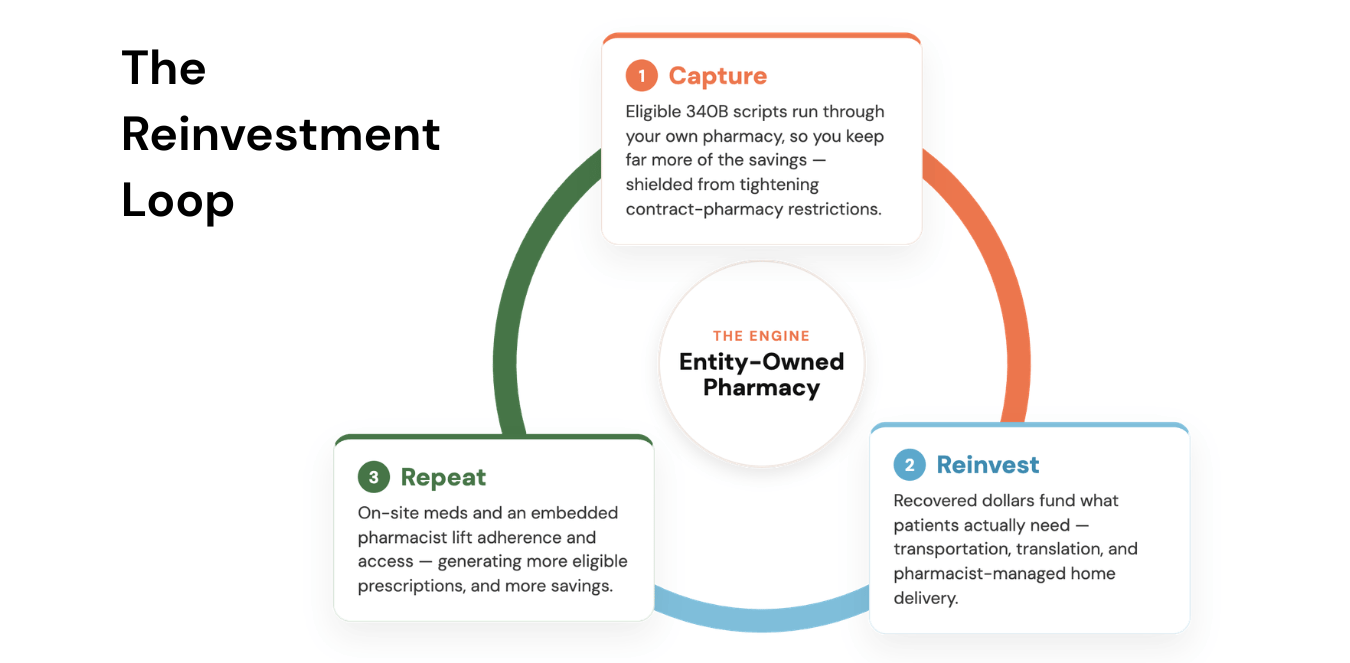
The savings aren't the finish line. They're the fuel. As one Pennsylvania FQHC CEO shared with us, “We went from about a third of patients filling their prescriptions to nearly nine in ten after launching home delivery,“ adding that the recovered dollars funded transportation and translation services for the community.
That's the loop worth building toward: capture, reinvest, repeat.
How do you know your health center is ready?
Four honest questions tell you most of what you need to know.
Volume. How many prescriptions do your patients fill each month, and what share is 340B-eligible? Higher eligible volume means a faster path to sustainability.
Capital. Construction, fixtures, technology, opening inventory, and staffing all require money before revenue ramps. The functions a pharmacy program actually needs add up fast, and NuvemRx estimates they can run $1.9M to $2.4M a year to staff in-house. Most health centers don't build that bench alone.
People. The pharmacy talent market is tight. Will you build and staff a team, or bring in a partner who already has one?
Compliance capacity. A pharmacy carries real regulatory weight. Someone has to own it, or you inherit audit exposure you didn't budget for.
If those answers give you pause, that's not a reason to stop. It's a reason to bring in help that already has the bench.
The steps to launch an in-house pharmacy program
Every launch follows the same arc. Plan on roughly nine months from kickoff to go-live, though state licensing timelines vary.
- Plan and design. Start with a feasibility assessment: your prescription volume, the share that's 340B-eligible, and the budget to support a build. Choose a site your patients will actually use, visible and on the path they already walk, then design the layout and order casework. This is also when the business scaffolding goes up: forming the entity or DBA, opening a bank account, and setting up the accounts a pharmacy can't operate without.
- Build. Manage construction, fixtures, and technology: assess bids, award a general contractor, run permitting, and keep the schedule tight. NuvemRx estimates an average-size health center's program can potentially generate roughly $40,000 to $50,000 a month in net savings by its second year, so every month before go-live is savings deferred. Schedule discipline is money, which is why the right partner may be able to offer start-up financing to assist with the initial buildout of the pharmacy, so a capital constraint never stalls a program that has the potential to pay for itself.
- License and credential. This is what gates your opening, so start early and mind the sequence. You'll need a State Board of Pharmacy permit, DEA registration, an NPI and NCPDP number, PBM contracting (usually through a PSAO), and 340B registration in OPAIS, plus a wholesaler account set up for both retail and 340B purchasing so you can stock the shelves. A state Board inspection, and sometimes a DEA inspection, stands between you and go-live. These applications are exacting, and one filed incorrectly can cost months.
- Staff and train. Hire your pharmacist-in-charge, technicians, and, increasingly, a clinical pharmacist, then train them on the dispensing system and your standard operating procedures. Plan for the recruiting to be hard: pharmacists and technicians are in short supply nationwide, and a mission-driven safety-net role competes with retail chains on pay. Start early, and hire people who want to serve your community, not just fill scripts.
- Integrate. This is where a pharmacy stops being a room and becomes part of the care team. Connect it to your EHR and dispensing system, your claims and eligibility engine, and your referral workflows so data flows and eligible prescriptions get captured instead of leaking out in the handoffs. Then stand up the patient engagement that actually drives program success: train providers to educate patients about the in-house pharmacy (a CMO or physician champion moves this faster than anything else), script your front-desk and clinical staff, and launch patient outreach, medication synchronization, and digital tools like refill reminders and a mobile app.
- Go live and optimize. Open with a soft launch and on-site support, plan for several days of hands-on help at go-live, then keep raising the program's ceiling. A maturing pharmacy adds centralized prior authorization and med-sync, advanced referral capture, automated compliance audits with standing checklists and SOPs, and real-time dashboards tracking script volume, savings, and provider satisfaction. The difference-maker is what happens with that data: a strong partner surfaces opportunities you'd otherwise miss, captured prescriptions slipping away, new-site assessments, budget forecasting, and expanded clinical services (delivery, immunizations, chronic-care management, and eventually specialty), so the program keeps growing the savings it returns to your community.
The hardest part is just starting
Every step above has a way to go wrong, and some mistakes are expensive: a Board of Pharmacy or DEA application filed incorrectly can cost you months. Doing it alone also means standing up a dozen-plus-role operation from scratch, a multi-year project on top of running your health center.
That's why most health centers don't launch alone. The right partner brings a team that has done this many times, handling the applications, credentialing, and build on your behalf and clearing deficiencies before they turn into delays, so you get a working pharmacy without assembling the whole organization behind it first.
What a unified model looks like
Most MSOs run your pharmacy. NuvemRx runs your entire pharmacy program.
The pharmacy is only one piece of a 340B program. A build-only partner runs the pharmacy and leaves you to bolt on the rest, a TPA, a referral vendor, an analytics tool, a compliance consultant, each its own contract and login, with value leaking through the gaps between them.
With NuvemRx, every piece is embedded in one partnership and one platform:
NuTPA. End-to-end 340B third-party administration: automated claims processing, real-time eligibility, manufacturer-block mitigation, and all HRSA-required reporting, with a full audit trail and a focus on minimizing reconciliation gaps between vendors.
NuReferrals. AI-powered identification of specialty scripts from outside providers, with automated 340B eligibility screening and closed-loop tracking that catches referral leakage, on the same platform as your pharmacy.
The Apollo platform. One consolidated dashboard across 340B, contract, and entity-owned pharmacy: real-time Rx volume, savings, compliance, and referral analytics, EMR-integrated and reached through a single login.
Continuous compliance. Automated monthly Rx audits and year-round manufacturer-block monitoring, with network-wide benchmarks that keep you audit-ready every day, not just before an HRSA review.
Mission Control. A named 340B strategy team reading network intelligence across 800+ covered entities and 70M+ patients, delivering ongoing optimization, split-billing strategy, payer-mix analysis, and savings-opportunity identification as a continuous partnership, not a quarterly PDF.
Full operational support. Licensing and credentialing, pharmacy build-out, payer contracting, prior-authorization management, patient engagement, quality reporting, and financial planning, all embedded, with no bolt-ons and no handoff gaps.
Managed as one connected program, every eligible dollar it protects keeps funding the care your community counts on.
What separates a real partner from a vendor
The build is the easy part to sell. The operation is the hard part to sustain. Before you sign anything, look for three things:
They build and they operate. Many pharmacy MSOs will construct your pharmacy and hand you the keys. The ones worth paying stay, running operations, compliance, and optimization long after the ribbon-cutting. Ask what happens in year two, not just at go-live.
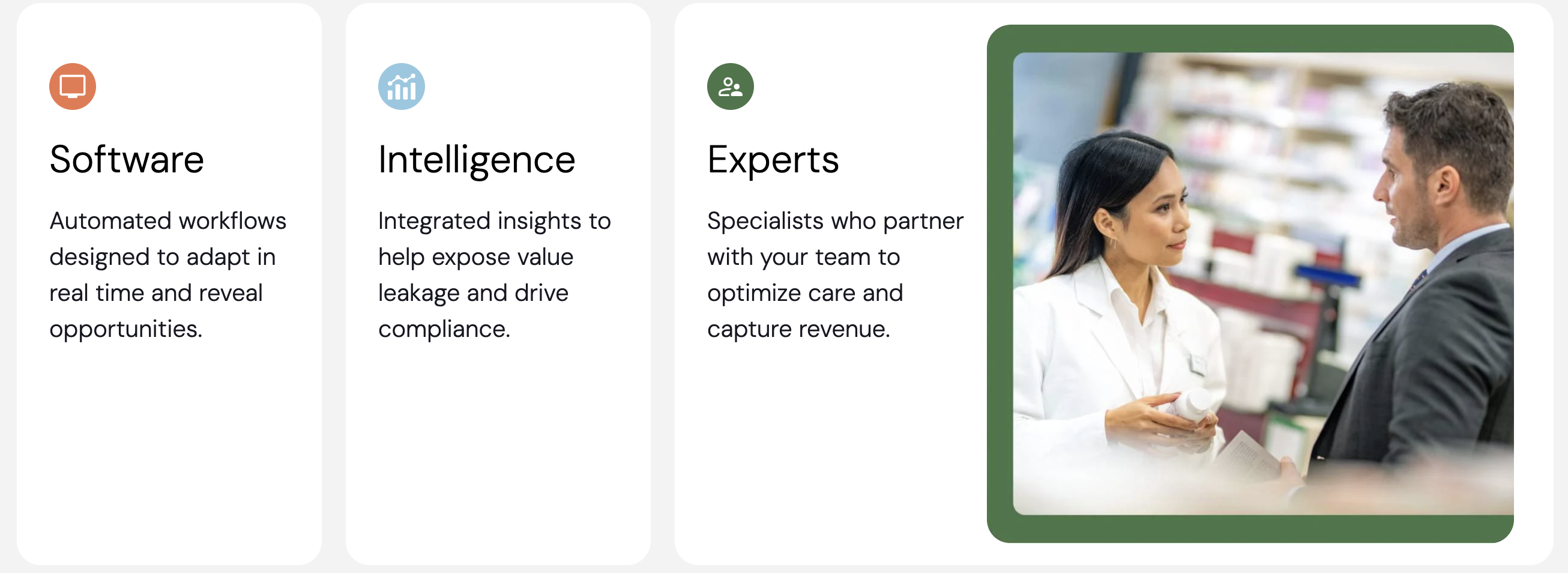
Software, intelligence, and people together. Pharmacy management systems matter, but software alone won't pass an inspection or coach a reluctant provider. Look for a partner that pairs real-time data with a named team of specialists who know 340B and safety-net operations, and who pick up the phone when you call.
Proof, and total focus on providers like you. Ask what they've actually done. NuvemRx has generated more than $2.6B in net savings across 800+ covered entities and 1.5B+ claims, with zero reported HRSA audit findings, while staying 100% dedicated to safety-net providers.
Don't treat FQHC compliance as an afterthought
340B is where audit risk concentrates: eligibility, no diversion, no duplicate discounts, auditable records. Build those safeguards into daily operations from day one, not after the first HRSA notice arrives. A clean, decade-long compliance record is rare. Ask any partner to show you theirs.
Build a pharmacy that funds the mission
Launching an in-house pharmacy is a serious undertaking. Done right, it turns a cost center into the engine that pays for another nurse, extended hours, or a mobile clinic, year after year. As one health center leader put it after bringing pharmacy services in-house, "We're making it easier for patients to access the care they need."
Start with your numbers. If you want to see what an in-house pharmacy could capture and fund for your health center, NuvemRx will run the analysis with you.
Frequently asked questions
How long does it take an FQHC to launch an in-house pharmacy?
Plan on roughly nine months from kickoff to go-live, though state licensing timelines vary. A partner that manages the build end-to-end keeps the schedule on track.
What's the difference between an in-house and a contract pharmacy?
An in-house (entity-owned) pharmacy is owned and operated by the health center, so prescriptions are filled on-site and more 340B savings stay with you. A contract pharmacy is a third-party retail location that dispenses your 340B prescriptions for a fee.
Should our pharmacy partner also handle 340B and referrals?
Yes. If they don't, you keep managing multiple vendors and lose eligible dollars in the gaps between them. A unified model that connects pharmacy management, third-party administration, and referral capture captures more and simplifies compliance.
* NuvemRx internal client metrics, from FQHC CEO