

Most 340B program managers can probably define referral leakage in a meeting. But very few can size it in their own program. That second gap is a real problem.
Across the NuvemRx network of 800+ covered entities, fewer than 1 in 3 are capturing their specialty referrals with the documentation needed to support 340B eligibility.* Zoom out to the ~14,000 unique 340B parent covered entities nationally and the active adoption rate is closer to 1 in 10.**
The other nine refer patients out, the specialist writes the script, and the resulting claim never connects back to the 340B program—where the savings could have funded the next service line, the next FTE, the next mobile clinic.
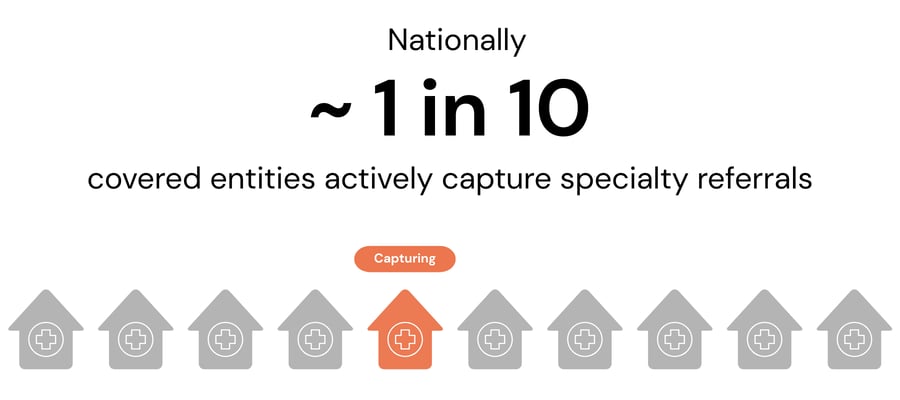 ** The ~1 in 10 national estimate compares the combined disclosed client footprints of major referral-capture vendors (≈ 1,350 covered entities) against the 13,300+ parent-covered entities in HRSA's Prime Vendor Program.
This is what referral leakage actually is. And in 2026, with IRA pricing compressing contract-pharmacy economics, it's one of the few specialty opportunities most programs still haven't worked—value that flows straight to patient care.
What 340B referral leakage actually is
Referral leakage is the gap between the prescriptions a covered entity is eligible to capture under 340B and the prescriptions it actually does capture.
The mechanism is straightforward. A patient sees one of your primary care providers. They get referred to an outside specialist—cardiology, endocrinology, neurology, ID, rheumatology, oncology. The specialist writes a script. The patient fills it at a pharmacy somewhere in your community. None of that information automatically flows back to your TPA. The script may be 340B-eligible if you can document that you own the patient's care, but if nothing in your workflow captures the referral and the resulting fill, that eligible prescription never makes it into your program.
This is not contract-pharmacy leakage—which is about routing your providers' scripts to a contracted dispensing partner. Referral leakage sits upstream of that. It's the eligible prescriptions that never reach your TPA at all—because the referral happened outside your walls.
It's also where the specialty therapies your patients most depend on concentrate.
The scale, in 2026 numbers
The 340B program has grown to ~14,000 unique parent covered entities operating across more than 57,000 registered sites, connected to roughly 30,000 contract pharmacy locations—with the number of contract pharmacies growing nearly fifteenfold between 2010 and 2020.*** There are more places than ever where an eligible script can slip through. But most programs' ability to actually capture those scripts hasn't grown with it.
An estimated 25%–35% of a covered entity’s contract pharmacy opportunity sits in referrals—and the top of that range is where specialty drugs cluster.
For most programs, that's a meaningful share of their patients' specialty prescriptions never captured.
The medications driving this are exactly the ones your highest-need patients depend on—cardiovascular drugs like Eliquis, diabetes therapeutics like Trulicity and Lantus, and the newer interleukin-inhibiting autoimmune drugs (Skyrizi, Tremfya, Bimzelx) that aren't subject to IRA pricing through at least 2030.
Why most programs leak: the HRSA documentation problem
The compliance bar is the reason most covered entities don’t have a referral capture program at all—and the reason most programs that do have one underperform.
Under HRSA’s “patient definition” guidance, a referred patient remains 340B-eligible only if the covered entity can prove it retained ultimate responsibility for that patient’s care. The NACHC Action Guide on 340B referral management describes the kinds of documentation that can support eligibility. The specific mix depends on your program's policies and may include:
- A documented relationship between the covered entity and the referral specialist — which can take the form of a formal referral order in the EMR, a documented acknowledgement of care, documentation of the patient’s care team, or similar evidence that you own the patient’s care.
- A complete return care summary — from the external specialist (diagnoses and treatment notes), obtained and maintained.
- Prescription documentation linkage — that ties the script written by the specialist back to the referred care event and the primary care record.
- Active care coordination evidence — documented outreach attempts to retrieve clinical notes within specified timeframes.
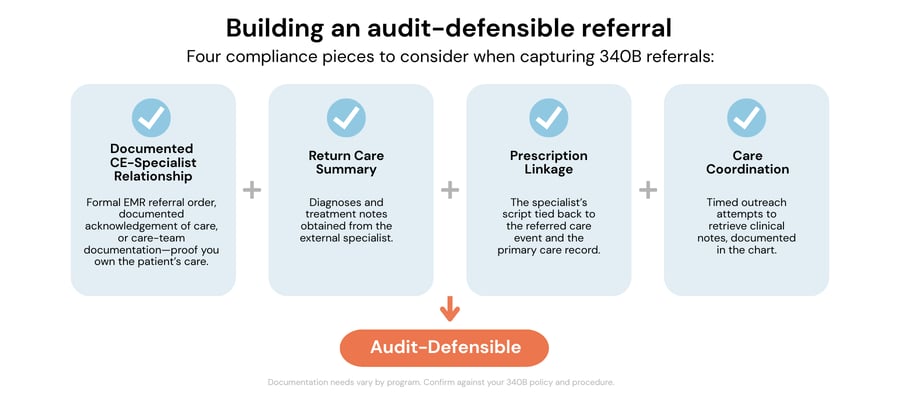
A claim holds up under audit only when your documentation shows you retained responsibility for the patient's care. If you have to chase the notes manually, you’re chasing them across dozens of specialists, each with their own release process, while a manufacturer restriction window quietly closes on the eligible script.
That documentation burden is why most programs leak. Not because no one is trying. Because the workflow needed to do this right doesn’t fit inside the time most program managers have.
The TPA capability gap
The market makes the problem worse. A peer-reviewed analysis of the 340B TPA landscape found that while standard program optimization and contract pharmacy revenue services are nearly universal across TPAs, referral capture is the exception:
- 45% of software-based TPAs offer referral capture modules.
- Fewer than 50% of consulting-based TPAs do.
In other words, more than half of the TPA market structurally cannot deliver referral capture even if the client asks for it. And among the TPAs that nominally offer it, the manual labor of specialty validation makes the work slow and expensive—exposure that falls on the covered entity whenever a TPA works without a guaranteed-yield model.
What capturing referrals actually requires
If leakage happens in three places—the EHR, the dispensing pharmacy, and the documentation queue—the fix has to address all three at once.
The difference between a one-time campaign and an ongoing system is what determines whether the gap stays closed—and a real system needs four things working together. It needs to ingest pharmacy claims data from a broad network—national, independent, specialty—and match it back to the patients your providers actually care for. It needs to operate in the clinical workflow, not weeks later when a dispensing report finally surfaces. It needs to automate eligibility at scale—NuReferrals, powered by par8o, automates up to 85% of the referral and eligibility process, which is what “fewer queues” looks like in practice. And it needs to be audit-defensible, with a documentation trail that holds up when HRSA asks.
That's not theoretical: across 10+ years with NuReferrals/par8o-captured claims included, there have been zero reported HRSA audit findings to date.
A referral capture campaign runs for a quarter, captures a backlog, and ends. A closed-loop system runs continuously. The backlog never builds because nothing ages out of real-time matching.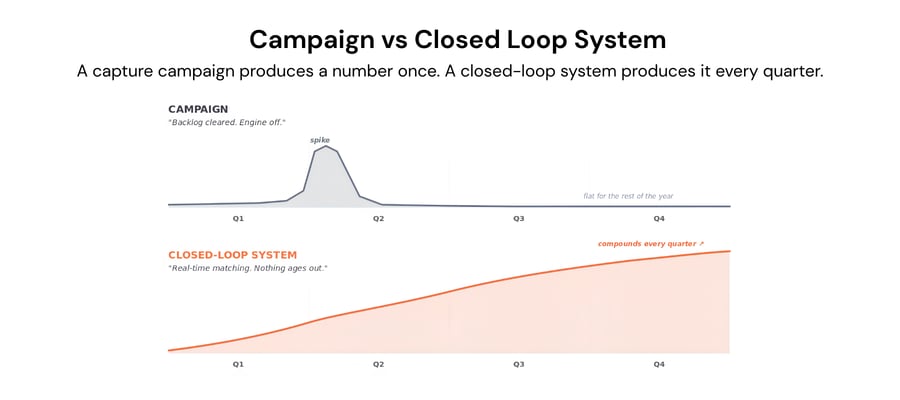
The 9 in 10 covered entities not actively capturing today aren’t there because they don’t care about specialty referrals. In our experience, most are there because they've tried a campaign-shaped fix and the results faded—or because their TPA simply doesn't have the module.
What “fixed” looks like
A community health center under financial duress asked for the narrowest possible scope to start—conservative compliance posture, one pharmacy partner. By the end of month one, the data justified expanding. By the second year, they had added the rest of their pharmacy network, brought specialty into the contract pharmacy mix for the first time, doubled program growth, and passed an HRSA audit with 100% of captured claims sustained.
A New England health center saw more than 100% program growth in just 6 months—new 340B-eligible claims captured from specialty referrals that were walking out the door. 100% of specialty scripts—previously lost to outside pharmacies—are now captured with the documentation to support them. They didn't hire more staff or build new infrastructure. They simply connected prescriptions their patients were already filling elsewhere to the program that funds their care.
A Mid-Atlantic DSH hospital captured 4,074 additional claims from Walgreens referrals alone.
The stakes for getting this right aren’t abstract. In a 340B Health survey of safety-net hospitals, 86% said proposed cuts to the 340B program would directly damage clinical care—specifically oncology and infusion services. 74% said the impact would hit pharmacy services. More than two-thirds said it would diminish their capacity to provide uncompensated care.
Specialty referral capture is one of the few growth levers still moving in the right direction in 2026. In a year when most other 340B margin levers are shrinking, that matters.
What this funds
A rural Arizona health center used 340B savings to hire an overnight obstetrician. The community had a real maternal-fetal mortality problem and no way to fund the position out of grants or visits. The Chief Pharmacy Officer’s reaction when the cross-functional team realized the pharmacy program was the only viable funding source: “Isn’t this exactly what 340B is for?”
The Mid-Atlantic FQHC listed it out themselves: dental care, behavioral health, diabetes education, comprehensive medication reviews, patient case management—all funded by the 340B program, all only possible because the program kept growing.
And the rural New England health system? They used 340B referral capture savings to fully fund specialty clinics across hematology, oncology, neurology, and endocrinology—and to operate three regional renal dialysis centers.
This is the part of the math that doesn’t show up on a TPA dashboard. Specialty referral capture isn’t an accounting exercise. It’s the cash flow that funds the services the community walks in the door for.
What to do this week
Three things:
Find out your specialty capture rate. Not your contract-pharmacy capture. Not your in-house script volume. The percentage of specialty prescriptions generated for your patients—from both in-house and referral providers—that your program is actually capturing. If your TPA can’t answer that question directly, the answer is probably “we don’t know.”
Audit your HRSA documentation chain. Pull a sample of referrals from the last 90 days and check whether you can produce the documentation your 340B policy calls for. Wherever you can't, that's where referrals are leaking.
Compare campaign to system. A campaign produces a number once. A closed-loop system produces it every quarter, every year, every audit cycle.
If you don’t know your specialty capture rate, that’s the answer.
Let’s look at your numbers.
* NuvemRx Mission Control Q1 2026 network analysis, internal
** The ~1 in 10 national estimate compares the combined disclosed client footprints of major referral-capture vendors (≈ 1,350 covered entities) against the 13,300+ parent-covered entities in HRSA's Prime Vendor Program.
*** IQVIA, "Growth of the 340B Program Accelerates in 2020," whose underlying data is HRSA's Office of Pharmacy Affairs (OPAIS).