
Advanced referral savings fell 26.7% in Q1 2026. The lever that still moves is specialty—and it sits in pharmacies most programs never registered. Why a standard proforma projects almost nothing for referral capture, what one Indianapolis FQHC captured instead, and why the OPAIS registration window closes soon.
.png)
Advanced referral savings fell sharply this year. The lever that still moves is the one your financial model can't project—and the registration window closes October 15.
Advanced referral total savings dropped 26.7% year over year in Q1 2026. Same programs. Same work. Less money.
That isn't a performance problem, and it won't be fixed by working your existing program harder. It's compression, it came from outside your building, and it means every compliant claim you capture now carries more weight than it did a year ago. An advanced referral claim averages $387 in 340B savings. Miss 10 of them and that's $3,870 that never reaches a patient.
Here's what most programs miss. That value isn't spread evenly across your referrals. It concentrates.
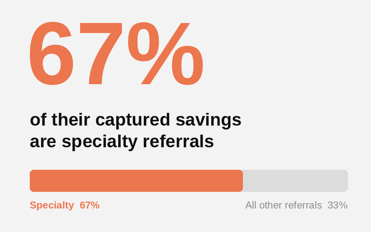
Jane Pauley Community Health Center, an FQHC in Indianapolis, has captured $2.1 million in net 340B savings before fees over 15 months. Two-thirds of it—67%, roughly $1.4 million—came from specialty referrals, led by Humira and biosimilars. Low volume. High value. A small number of claims doing most of the work.
Which raises the obvious question. If that's where the money is, why doesn't every program have it?
Specialty scripts don't fill where you can see them
Because specialty medications don't come through your entity-owned pharmacy.
Your provider writes the referral. The patient sees the specialist. Then a commercial payer steers that patient to a specific specialty pharmacy. The patient doesn't get a vote, and neither do you.
If that pharmacy isn't registered to your program, the whole thing happens without you. The referral gets made. The patient gets the drug. The savings land nowhere.
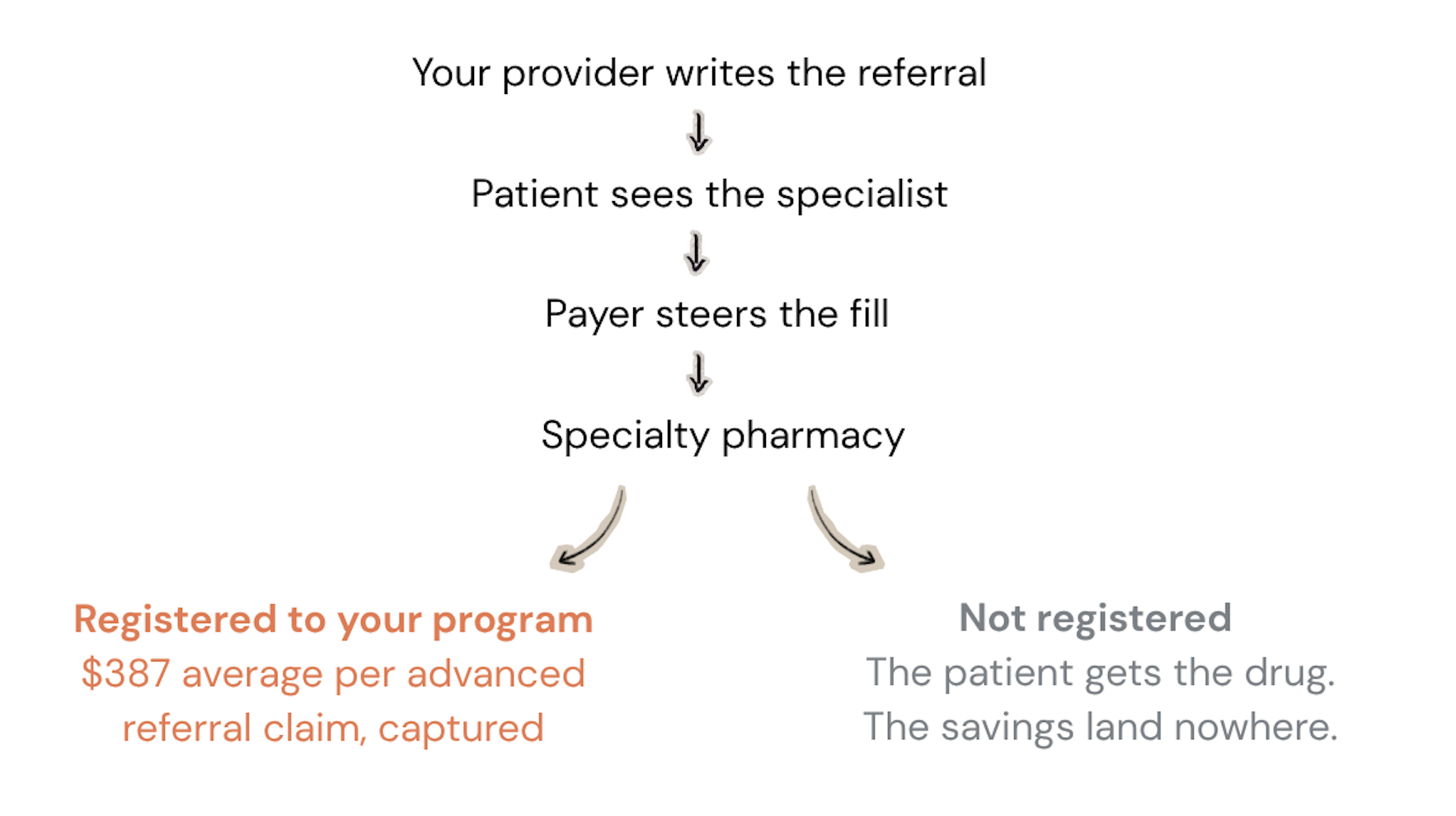
This is why capture is a network problem before it's a software problem. Finding the referral is the easy half. Total market access—capturing the script wherever it fills, across national chain, regional retail, independent, entity-owned, and specialty pharmacies—is the half that produces dollars.
Register them anyway
Here's the objection that comes up the moment anyone suggests adding these pharmacies to your network.
Most of the largest specialty pharmacies are owned by pharmacy benefit managers. At least one of those parents also owns a 340B third-party administrator—and that specialty pharmacy markets referral capture help to health centers, names its sibling TPA on the page, and calls the arrangement greater opportunity to expand the claims pool.
Greater opportunity for whom is worth asking.
Staying out of those networks doesn't answer it, though. Your patients are already being sent there, and the savings on those scripts are legitimately yours. Registering a pharmacy doesn't hand anyone your program. What decides that is who holds the capture, and a partner whose economics don't change based on where a script fills has no reason to steer it anywhere.
Why your model will tell you not to do this
Now the part nobody mentions before you build the business case.
A standard proforma runs off your provider profile—your prescribers, your patients, your fills. Referral capture is none of those. It's scripts for your patients not written by your providers that somebody else filled somewhere else. The model has nothing to project from, so it returns a number near zero, and a real opportunity gets declined in a spreadsheet review.
This one has to be stood up and then measured. Figure on 90 to 180 days after go-live before the true number is visible.
What the proof looks like
JPCHC didn't arrive here smoothly. They left for a competitor's lower rate, then came back after an internal audit review. Dr. Christy Davis, PharmD, their Director of Pharmacy Operations:
"Ultimately it came down to trust. During our internal audit reviews, every claim that we had an issue finding appropriate documentation as to why it passed as a referral was captured by [the other vendor]. At that point, the liability risk was not worth the lower rate."
Since returning, JPCHC's program grew 87% across 2025—$108,000 in January to a $202,000 December peak. And 67% of their captured savings are specialty referrals.
 Network breadth shows up the same way elsewhere. A multi-entity rural health system captured roughly $1.3 million through NuReferrals in about a year, against roughly $40,000 from a competing TPA's referral product over the same period, same pharmacy mix. Same scripts. Different reach.
Behind both: zero confirmed HRSA findings on referral claims in 10 years, across the largest dedicated referral capture network in 340B.
The window
The OPAIS contract pharmacy registration period runs October 1 through 15. Pharmacies registered in that window are eligible January 1, 2027. Miss it and the next practical start is a year out.
Four questions to take into your next conversation with your Client Success Manager. Which major specialty pharmacies aren't registered to your program right now? What does payer steerage look like in your commercial book? Who inside your organization files the registration, and by when? And how will you evaluate this at 90 and 180 days instead of at signature?
Every specialty claim you capture is $387 that pays for something real. At Jane Pauley, that $1.4 million funds pharmacy staff and patient services in Indianapolis that no grant line covers. Pharmacy is the engine. The question is how much of it you have connected.
Working with a NuvemRx CSM? Ask for your specialty network review before October 15. They can tell you which major specialty pharmacies your program is missing and what adding them is worth to you in 2027.
Not yet a client? Start a conversation with us below.
This article is general information for 340B covered entities and is not legal, tax, accounting, or financial advice. Figures reflect NuvemRx Mission Control network data for Q1 2026 and client reporting for Jane Pauley Community Health Center from January 2025 through March 2026; single-client results are specific to that organization's program, payer mix, and pharmacy network, and outcomes vary. It reflects the HRSA OPAIS contract pharmacy registration period of October 1–15, 2026, for a January 1, 2027 effective date, and the status of that window as of September 2026; registration periods, eligibility requirements, and effective dates are set by HRSA and may change. Descriptions of payer steerage and specialty pharmacy ownership are general and drawn from publicly available materials; specific arrangements differ by plan, by pharmacy, and by market. Whether a particular pharmacy can be registered to your program, and whether a particular claim is 340B-eligible, depends on your own program configuration and compliance review. Consult your own advisors, and confirm the requirements that apply to your organization.