
.png)
How do FQHCs capture more 340B savings across pharmacy channels? By seeing all of them at once.
A health center's 340B prescriptions flow through three distinct dispensing channels—contract pharmacy, referral capture, and entity-owned (in-house) pharmacy—and eligible savings leak in the gaps between them.
The health centers that capture the most aren't the ones that picked the "best" pharmacy. They're the ones with visibility across every channel their patients use.
That's the whole argument of this piece, and it's worth two minutes to hear it from someone who sees the entire market. NuvemRx CEO Scott Seidelmann lays out why total market access changes what a 340B program can capture:
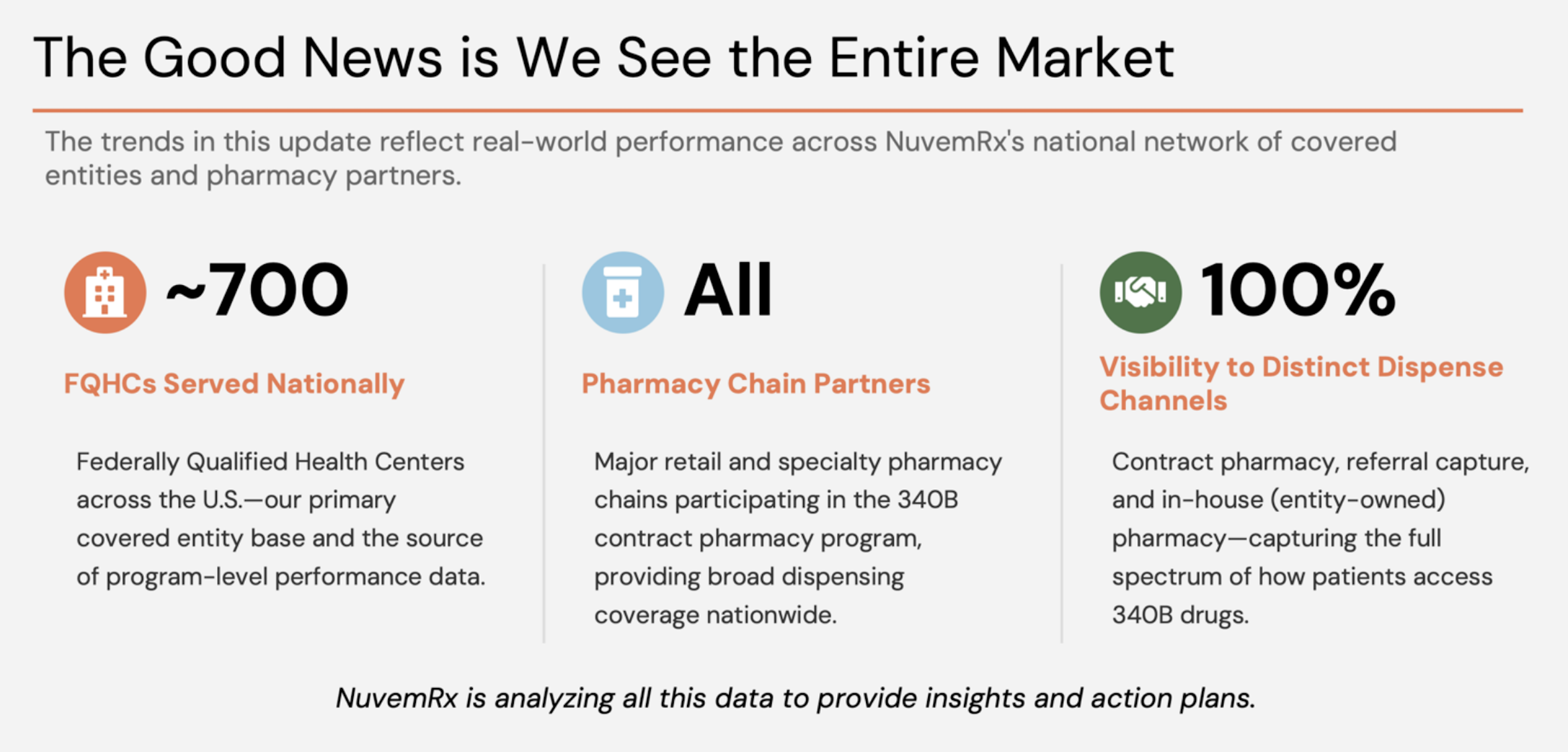
"We cover pretty much half the FQHCs in the United States… we work with every pharmacy chain… and there are three ways your patients access scripts."
— Scott Seidelmann, CEO, NuvemRx
What does total market access actually mean?
Total market access means one connected view of every channel your 340B prescriptions move through, instead of a separate report for each. As Scott describes it, that comes down to the three ways patients access scripts:
- Contract pharmacy — your provider writes the script; the patient fills it at a retail or chain pharmacy.
- Referral capture — your provider refers the patient to an outside specialist, and shared clinical data lets you capture the 340B savings on what that specialist prescribes.
- Entity-owned (in-house) pharmacy — your own pharmacy, where you keep the patient, the data, and the full margin.
The national chains your patients already use aren't a problem to route around. They're a huge share of how 340B drugs reach patients—and a huge share of where savings can be captured. The advantage isn't avoiding them. It's seeing them alongside every other channel, in one connected view. That's the Unified Pharmacy Care Model.
This is where the par8o referral capture engine—now the engine behind NuReferrals—changes the math. Its data relationships with the national chains mean the specialty scripts that fill at a Walgreens or CVS don't vanish into someone else's system. They get seen, matched, and captured—along with the independent and specialty pharmacy volume most programs never ingest.
What does that visibility recover?
One mid-Atlantic DSH captured 4,074 additional 340B claims it had been missing—from referrals filled at Walgreens. Not by switching pharmacies. By finally seeing volume that was always eligible and always flowing, just invisible until the data connected.
The contrast gets sharper elsewhere. One rural referral system ran NuReferrals against a competing referral product for a full year—same pharmacy mix, same window—and captured about $1.3M in net 340B savings versus roughly $40K from the other product. That 32x difference wasn't a better report; it funded expanded access for a rural community.
That's what total market access buys: not a better report, but reinvestable cash flow—the captured script that becomes an extended clinic hour, a care coordinator, a service line your community has been waiting on.
Your savings don't live in one pharmacy. The health centers that capture the most are the ones who can see them all.
Frequently asked questions
What are the three 340B dispensing channels?
Contract pharmacy (retail/chain fills on a provider's script), referral capture (340B savings on prescriptions from outside specialists a patient is referred to), and entity-owned or in-house pharmacy (the covered entity's own pharmacy).
Does NuvemRx use AI for referral capture?
Yes—NuReferrals has used AI for years, with up to 85% of the referral process automated through par8o. But AI is one part of how we capture savings, not the whole story. Finding a referral is only the first step; capturing it means engaging the specialist, reaching the pharmacy where the script actually fills—including national chains like Walgreens and CVS—and completing the dispense. That mix of automation, referral experts, and total market access is what turns a referral into savings your community can reinvest.
Does filling at Walgreens or CVS reduce 340B savings?
No. National chains are a major way patients access 340B drugs. The savings are captured when you have visibility into the referral and dispensing data flowing through those chains—which is what referral capture provides.
Want to see how much eligible volume is flowing through channels you can't currently see?
Let’s look at your numbers.
Bookmark this link for continually updated resources and insights to help pharmacy become the engine that drives expanded care for your community.